
Synthetic vs. Conventional Motor Oil for Everyday Drivers
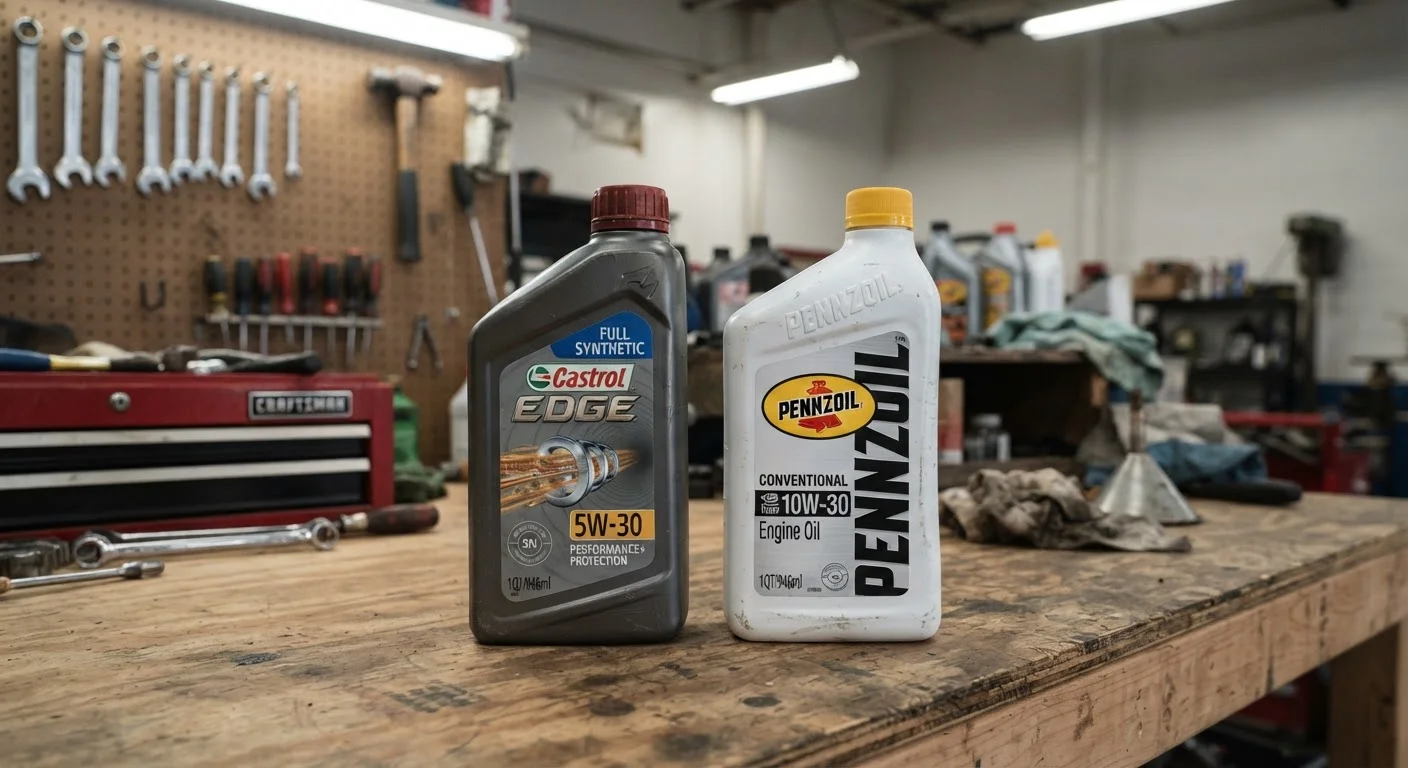
Photo credit: grub-cafe.com
In this article
Synthetic oil costs more upfront but offers real advantages. Compare both types across performance, interval length, and long-term engine impact.
Key Takeaways
- Synthetic oil typically costs two to four times more per quart than conventional oil, but lasts significantly longer between changes.
- Conventional oil suits older engines and low-stress driving; synthetic performs better in extreme heat, cold, and high-load conditions.
- Many modern vehicles require synthetic oil per the manufacturer's specification, so checking your owner's manual is the first step.
- The total annual cost difference between oil types is often smaller than it appears once change frequency is factored in.
- Switching from conventional to synthetic in a high-mileage engine can sometimes cause minor leaks if seals are already worn.
What actually separates the two oil types
Conventional motor oil is refined directly from crude oil and contains natural hydrocarbon molecules of varying sizes. Synthetic oil starts with the same base stock in many cases, but the molecules are chemically restructured to be uniform in size and shape. That uniformity is the reason synthetic oil behaves more predictably under stress.
Because conventional oil retains naturally occurring impurities and molecular irregularities, it breaks down faster when exposed to heat, load, and time. Synthetic oil resists oxidation longer, which is why manufacturers rate it for longer drain intervals. This is not marketing language; it reflects a measurable difference in how long the oil maintains its protective film between metal surfaces inside the engine.
There is also a third category worth knowing: synthetic blend oil, which mixes conventional and synthetic base stocks. Blends offer moderate performance at a price between the two full types. For most everyday drivers, the choice comes down to full synthetic versus conventional, with blends as a middle path if budget is the primary concern.
Cost comparison: what you actually pay per year
A quart of conventional oil typically runs between $5 and $8. A quart of full synthetic runs $9 to $13 or more, depending on viscosity grade and brand. A standard oil change uses four to six quarts, so the per-service price difference is real, usually $20 to $40 higher for synthetic.
Where the math gets interesting is annual cost. If conventional oil requires a change every 4,000 miles and you drive 12,000 miles per year, you pay for three changes. If synthetic lasts 10,000 miles, you pay for slightly more than one change per year. At those numbers, the annual difference in parts cost alone can narrow considerably, sometimes to less than $30.
| Criterion | Synthetic motor oil | Conventional motor oil |
|---|---|---|
| Cost per quart (approximate) | $9 to $13 | $5 to $8 |
| Typical change interval | 7,500 to 10,000+ miles | 3,000 to 5,000 miles |
| Cold-temperature flow | Flows faster at low temps | Slower to circulate when cold |
| Heat resistance | Stable under high heat | Degrades faster under heat |
| Compatibility with older engines | Can expose worn seals | Generally well-suited |
| Required by many new vehicles | Yes, commonly required | Rarely specified for new engines |
Labor costs follow the same logic. Fewer changes mean fewer trips to a shop, fewer hours of your time, and less used oil to dispose of. For families managing busy schedules, that friction reduction has real value beyond the dollar figure.
Engine protection and performance differences
The most important function of any motor oil is to keep metal components separated by a thin lubricating film. When that film fails, metal touches metal, and wear accelerates. Synthetic oil maintains a more stable viscosity across a wider temperature range, which means the film holds up better during cold starts in winter and under sustained highway driving in summer.
Cold starts account for a disproportionate share of engine wear over a vehicle's lifetime. When an engine sits overnight, oil drains down into the pan. At startup, there is a brief moment before oil pressure builds and reaches upper engine components. Synthetic oil flows faster at low temperatures, reducing that window of marginal lubrication. This matters more in climates that drop below 20 degrees Fahrenheit regularly.
For high-mileage engines, the picture is more complicated. Engines with 100,000 or more miles may have worn seals that conventional oil's slightly thicker film (at operating temperature) helps to manage. Switching to synthetic in these engines can sometimes expose existing seal wear, leading to minor leaks. This is not a universal outcome, but it is worth discussing with a mechanic before switching on a high-mileage vehicle.
How to decide which oil your vehicle actually needs
The owner's manual is the authoritative source. Many vehicles built after 2010 specify full synthetic, and using conventional oil in those engines can void warranty coverage or leave the engine under-protected. If the manual specifies a viscosity grade such as 0W-20 or 5W-30, the oil you choose must match that grade regardless of type.
Driving conditions also matter. Short trips under five miles, frequent towing, or consistent stop-and-go city driving all stress oil more than steady highway miles. Under those conditions, synthetic's longer stable life is an advantage even if your vehicle does not explicitly require it.
If your current vehicle uses conventional oil and is running well, there is no compelling reason to switch unless you are approaching a mileage milestone, changing driving patterns, or dealing with temperature extremes. For families buying a used vehicle, verifying what oil type the previous owner used and what the manufacturer specifies should happen before the first oil change.
This article is for general informational purposes only. Consult your vehicle's owner's manual and a qualified mechanic for guidance specific to your engine and driving conditions.

Author
Automotive Editorial Team
Automotive Editorial Team is the collective byline for our editorial team and contributor network. Articles published under this byline or an editorial pen name are researched, written, and reviewed according to our editorial standards for clarity, consistency, and independence before publication.
View all articles →