
Dealer Service Centers vs. Independent Mechanics: Weighing the Trade-offs
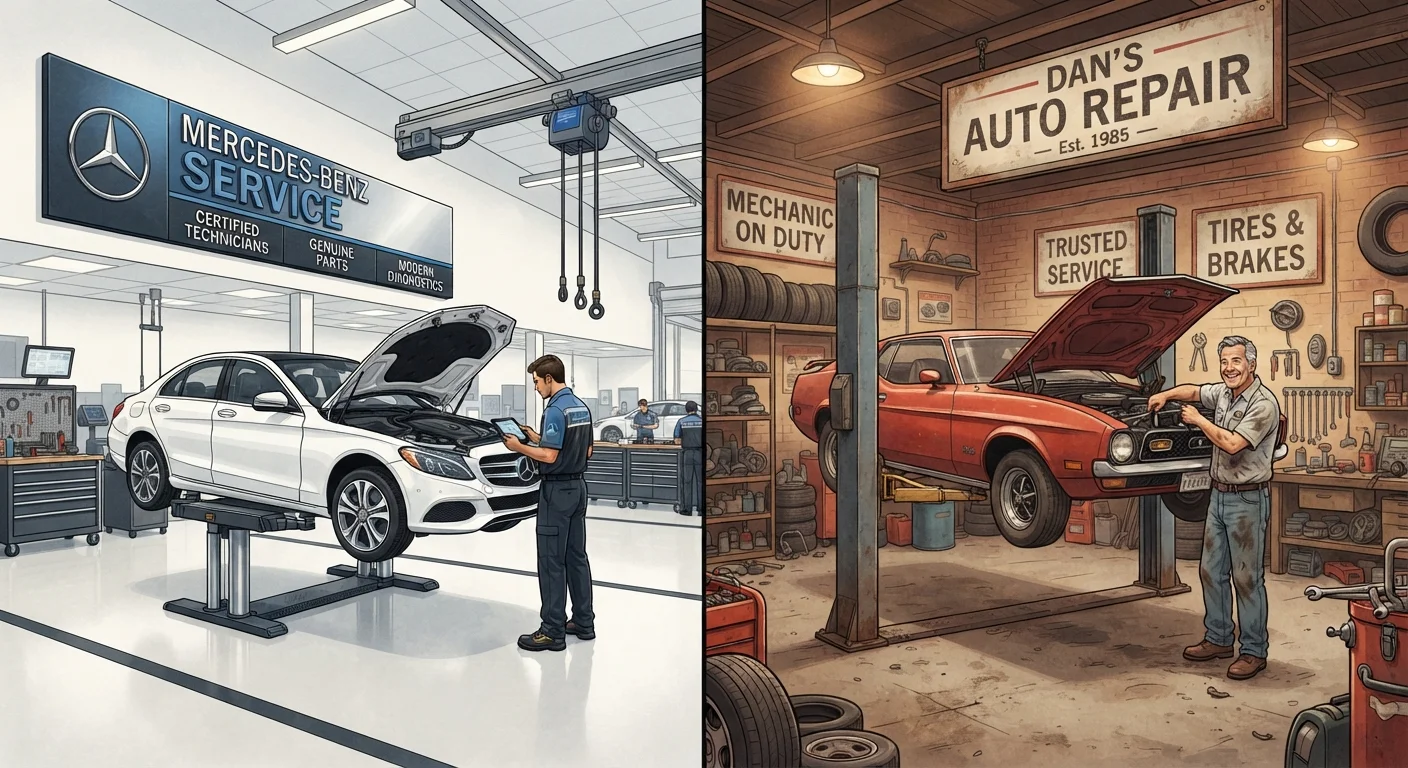
Photo credit: grub-cafe.com
In this article
Both options have genuine strengths and real limitations. Here is how to think through the choice based on your car's age, warranty, and repair type.
Key Takeaways
- Dealer service centers use manufacturer-trained technicians and OEM parts, which matters most for newer vehicles under warranty.
- Independent mechanics typically charge less per hour and can be more flexible on parts sourcing.
- Warranty coverage rules have nuances: federal law generally protects your right to use independent shops without voiding a new-car warranty.
- The right choice often depends on your car's age, the complexity of the repair, and your local shop options.
- Getting a written estimate before any work begins is good practice regardless of which type of shop you use.
Manufacturer-trained technicians for your vehicle brand
Dealer technicians complete brand-specific training programs and have access to factory technical bulletins and software updates that independent shops may not receive.
OEM parts used as standard
Original equipment manufacturer parts match the exact tolerances the vehicle was built with, which matters most for complex assemblies and newer models with tight calibration requirements.
Warranty and recall work handled in one place
Recall repairs and warranty claims require factory authorization and tooling that only a franchised dealer can provide, making the dealer the only practical option for those services.
Proprietary diagnostic tools for complex issues
Many modern vehicles require manufacturer-specific software to read fault codes accurately and reprogram modules, hardware that most independent shops do not carry.
Higher labor rates than independent shops
Dealer labor rates often run $20 to $70 more per hour than comparable independent shops, and that difference compounds on multi-hour jobs like timing chain replacements or transmission services.
Less flexibility on parts sourcing
Dealers generally install OEM parts only, removing the option to use quality aftermarket alternatives that can cost significantly less for common wear items like brake rotors and filters.
Service advisor turnover can affect continuity
High staff turnover at some dealer service departments means the person handling your car may not know its history, increasing the chance that past issues or prior repairs are overlooked.
Wait times can be longer for routine work
Dealer service bays prioritize warranty and recall work, which can push routine maintenance appointments to longer waits compared to a smaller independent shop with more scheduling flexibility.
What sets these two options apart
Dealer service centers are run by franchised dealerships and staffed by technicians who receive training from the vehicle manufacturer. They have access to proprietary diagnostic software, technical service bulletins, and original equipment manufacturer (OEM) parts, meaning parts made to the exact specifications the automaker requires. Independent mechanics operate privately, are not affiliated with any brand, and source parts from a broader market that includes OEM-equivalent aftermarket components.
Labor rates at dealerships run higher on average, often between $100 and $200 per hour depending on the region and brand. Independent shops typically charge $75 to $130 per hour for comparable work, though rates vary widely. Parts costs also differ: OEM parts from a dealer carry a premium, while a quality aftermarket part from an independent shop can cost less without sacrificing performance for most repairs.
Understanding what your maintenance schedule actually requires helps you judge which shop type is the right fit for each service interval.
The case for dealer service centers
Manufacturer-trained technicians for your vehicle brand
Dealer technicians complete brand-specific training programs and have access to factory technical bulletins and software updates that independent shops may not receive.
OEM parts used as standard
Original equipment manufacturer parts match the exact tolerances the vehicle was built with, which matters most for complex assemblies and newer models with tight calibration requirements.
Warranty and recall work handled in one place
Recall repairs and warranty claims require factory authorization and tooling that only a franchised dealer can provide, making the dealer the only practical option for those services.
Proprietary diagnostic tools for complex issues
Many modern vehicles require manufacturer-specific software to read fault codes accurately and reprogram modules, hardware that most independent shops do not carry.
One area where dealers hold a clear advantage is warranty work. If your vehicle is still covered by a manufacturer's bumper-to-bumper or powertrain warranty, taking it to the dealer keeps the claim process straightforward. Recall repairs, technical service bulletin updates, and software reprogramming almost always require dealer-level tools and factory authorization.
Dealers also carry liability for the work they perform on your specific vehicle model in a way that creates accountability. If a problem recurs after a dealer repair, you have a direct line to the manufacturer's customer relations process.
The case for independent mechanics
Higher labor rates than independent shops
Dealer labor rates often run $20 to $70 more per hour than comparable independent shops, and that difference compounds on multi-hour jobs like timing chain replacements or transmission services.
Less flexibility on parts sourcing
Dealers generally install OEM parts only, removing the option to use quality aftermarket alternatives that can cost significantly less for common wear items like brake rotors and filters.
Service advisor turnover can affect continuity
High staff turnover at some dealer service departments means the person handling your car may not know its history, increasing the chance that past issues or prior repairs are overlooked.
Wait times can be longer for routine work
Dealer service bays prioritize warranty and recall work, which can push routine maintenance appointments to longer waits compared to a smaller independent shop with more scheduling flexibility.
For vehicles past their warranty period, the cost gap between dealer and independent labor becomes harder to justify on routine jobs. Oil changes, brake pad replacements, tire rotations, and cooling system flushes do not require factory diagnostic tools. A well-equipped independent shop with experienced technicians handles these repairs reliably and at a lower total cost.
Independent shops also tend to offer more flexibility. Some will let you supply your own parts, which can reduce costs further. A mechanic who has serviced your car for years builds familiarity with its history in a way that rotating dealership service advisors rarely match.
When keeping repair costs down is a priority, an independent shop is often the more practical starting point for out-of-warranty vehicles.
Warranty rules most drivers misunderstand
Your warranty and independent shops
The Magnuson-Moss Warranty Act generally protects consumers from having a new-car warranty voided solely because they used a non-dealer shop for maintenance or repairs. The key conditions are that the work must be done correctly and with parts meeting manufacturer specifications. Keep all receipts and service records from any shop you use. If your warranty includes specific language about authorized service providers or software updates, read those terms carefully before routing work away from the dealer.
A common concern is that using an independent mechanic will void a new-car warranty. The Magnuson-Moss Warranty Act, a federal law, generally prohibits manufacturers from voiding a warranty simply because an owner used a third-party shop for maintenance, as long as the work was performed correctly and with appropriate parts. You should keep all service records and receipts from any independent shop. If a warranty dispute arises, documentation showing that the correct oil grade, filter specification, or fluid type was used protects your position.
There are exceptions. Certain high-performance or specialty warranties may have tighter terms, and software-related updates may still require dealer equipment. Reading your warranty documentation is the only way to know what your specific coverage requires.
How to evaluate any shop before you commit
Regardless of shop type, the same due diligence applies. Look for ASE (Automotive Service Excellence) certification, which indicates a technician has passed standardized competency tests. Ask whether the shop has experience with your specific make and model, particularly for European or Japanese vehicles that use specialized systems.
Request a written estimate before work begins, and ask for the replaced parts back when it is practical. A shop that resists either request is worth approaching with caution. Small issues left unaddressed can grow into large bills regardless of which shop eventually handles them, so clear communication about what the inspection found matters as much as the price.
$94
Average independent shop hourly labor rate
AAA has reported that independent shop labor rates average around $94 per hour nationally, compared to higher averages at franchised dealerships.
~30%
Potential parts cost savings with aftermarket components
Consumer Reports has noted that quality aftermarket parts can cost roughly 20 to 40 percent less than OEM equivalents for many common repair categories.

Author
Automotive Editorial Team
Automotive Editorial Team is the collective byline for our editorial team and contributor network. Articles published under this byline or an editorial pen name are researched, written, and reviewed according to our editorial standards for clarity, consistency, and independence before publication.
View all articles →