
Keeping Kids Entertained on Long Flights and Drives Without Overspending
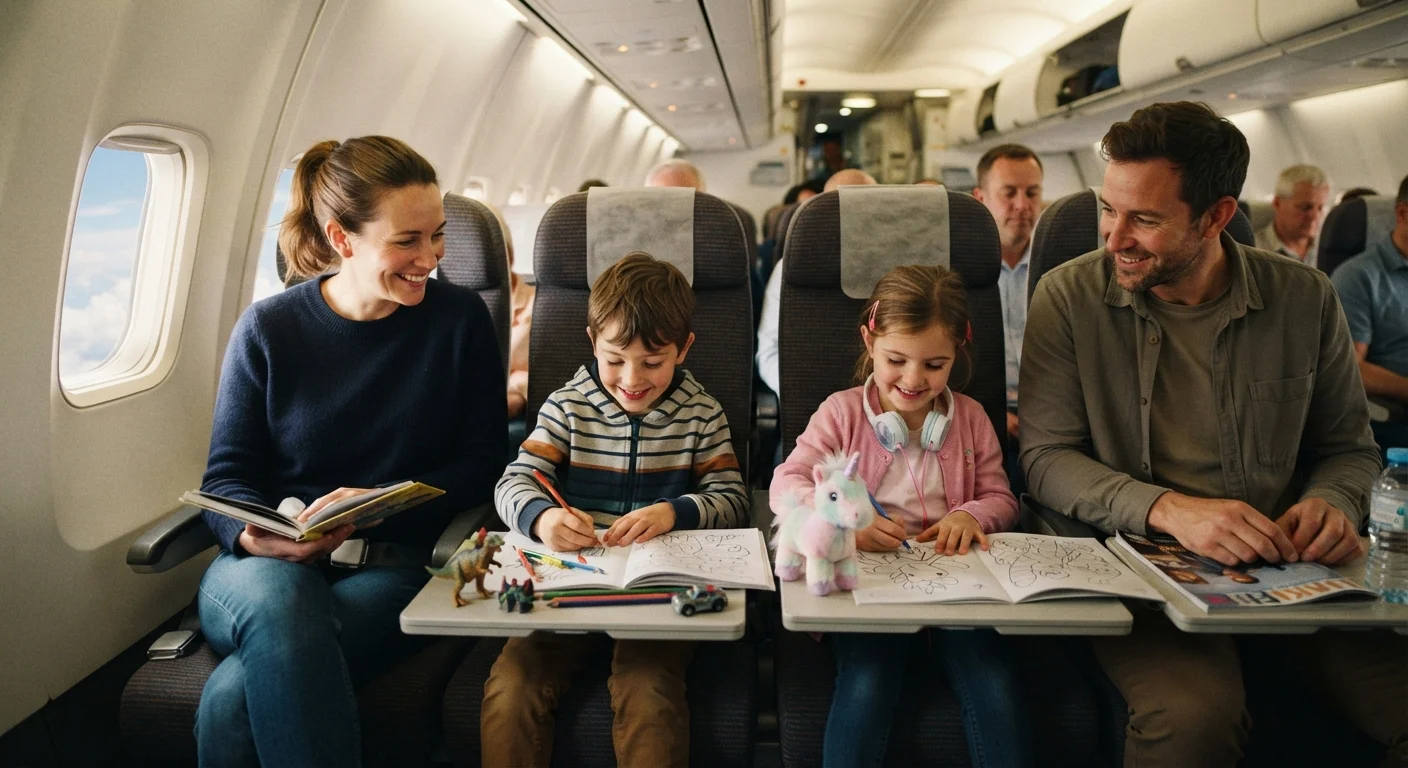
Photo credit: grub-cafe.com
In this article
Practical, low-cost strategies for managing boredom, meltdowns, and screen fatigue during long journeys with children of different ages.
Key Takeaways
- Downloading content before departure eliminates costly in-flight Wi-Fi charges for streaming.
- Rotating small, inexpensive activities in timed intervals works better than handing everything over at once.
- Physical activity breaks during road trips reduce meltdowns and cost nothing at rest stops.
- Age-appropriate games and conversation starters engage kids without any screen time or spending.
- Snacks packed from home can replace expensive airport or highway food stops for most journeys.
Why long journeys test family budgets as much as patience
The moment boredom sets in, the spending usually starts. A rushed airport toy purchase here, an in-flight movie rental there, a highway gas station impulse buy that nobody actually wanted. It adds up fast, and most of it goes entirely forgotten before you reach your destination.
The good news is that keeping kids genuinely occupied during long flights and drives does not require an expensive tablet bundle, a loaded digital subscription, or a bag full of brand-new toys. The strategies below are grounded in what actually holds children's attention at different ages, without demanding much from your wallet. If you are also thinking through the broader cost picture of your trip, our guide on planning an affordable family road trip covers route and lodging decisions that set your budget up well before you even get in the car.
Prepare your activity plan the night before
Pulling together your rotation bag, downloading content, and packing snacks the evening before departure takes less than an hour and prevents the rushed airport purchases that quietly inflate travel costs. A few minutes of preparation at home reliably replaces $20 to $30 of impulse spending on the road.
Eight practical ways to keep kids engaged without overspending
Download before you go, not during
In-flight Wi-Fi costs vary widely, but paying per device for a family can run into real money quickly. Before you leave home, download movies, podcasts, audiobooks, and episodes directly to each device. Most streaming platforms support offline viewing at no extra charge on a standard subscription. If your kids share one tablet, a downloaded playlist queued up for the trip covers several hours without a single in-flight dollar spent.
For road trips, this matters just as much. Streaming over a mobile data connection burns through a plan quickly. Downloaded content protects you from both data overage charges and the dead-signal stretches that reliably trigger backseat meltdowns.
Downloading content before departure removes the temptation and cost of in-flight Wi-Fi entirely.
Pack a rotation bag with small surprises
A "rotation bag" is exactly what it sounds like: a small tote loaded with inexpensive items your child has not seen before (or has not seen in a while), revealed one at a time throughout the journey. Sticker pads, activity books, a deck of cards, a small figurine, a travel-size magnet puzzle. Dollar-store finds and clearance picks work perfectly because novelty matters more than price.
The key is pacing. Hand over one item when attention starts to drift, not before. Spacing the reveals across a long flight can stretch what amounts to a $10 bag across four or five hours of genuine engagement.
Novelty matters more than price: a $2 sticker pad introduced at the right moment can hold attention for an hour.
Bring snacks from home and skip airport food stops
Airport food is expensive, highway rest stop food is expensive, and hungry kids compound every other problem on a long trip. Packing your own snacks from home cuts that cost directly. Trail mix, cut fruit in a reusable container, crackers, nut butter pouches, and granola bars all travel well and pass TSA liquid rules when portioned correctly.
Beyond the cost saving, familiar snacks are a reliable mood anchor. A snack break also doubles as a small scheduled activity, giving kids something to look forward to at regular intervals without requiring any screen time or preparation beyond what you already did at home. Our packing guide at packing for a family trip without paying baggage fees walks through what fits in carry-ons and how to share luggage smartly.
A snack from home costs a fraction of airport pricing and works as a built-in activity break.
Play no-equipment games that actually hold attention
License plate bingo, 20 Questions, the alphabet game, geography chains (each player names a place starting with the last letter of the previous answer), and storytelling rounds all require nothing except willing participants. Many of these scale well across age gaps: a seven-year-old and a twelve-year-old can both play geography chains without one of them being bored.
For flights, verbal games work in low voices and do not require a tray table or anything from the seatback pocket. They also bring adults into the activity, which matters more than parents often expect. Kids stay engaged longer when a parent is genuinely playing rather than supervising from the aisle seat.
Verbal games that include adults tend to hold kids' attention longer than solo activities, at zero cost.
Schedule physical breaks on road trips, not just fuel stops
Rest stops exist at regular intervals on most interstate routes, and many have open grassy areas where kids can run, stretch, and reset. A fifteen-minute movement break costs nothing and meaningfully reduces the tension that builds up in a confined space over several hours.
Plan movement breaks deliberately rather than treating them as optional. A family that builds in two or three short stops across a seven-hour drive arrives in noticeably better shape than one that pushes straight through. The stops also create natural transition points between activity blocks, making it easier to introduce the next item from your rotation bag or shift from screens to audio.
A fifteen-minute run at a rest stop costs nothing and does more for backseat morale than most paid entertainment.
Use audiobooks and podcasts designed for kids
Audio content is underused by most families, which is a real missed opportunity. A well-chosen audiobook or kids' podcast holds attention through long stretches, works for multiple children at once through a single speaker or shared earphones, and requires no screen time. Many public library systems offer free digital audiobook lending through apps; check whether your library system participates before you buy anything.
Story-driven audio works best during the quieter parts of a journey: when the novelty of departure has faded and before you arrive at a scheduled stop. For younger children, audio paired with a simple coloring sheet or sticker page gives their hands something to do while their minds follow the story.
Library audiobook apps make hours of story-driven audio free to borrow before you ever leave the driveway.
Give older kids a job during the journey
Tweens and older school-age children often do better when they have a defined role rather than just passenger status. Assign one child as the route-tracker (following along on a printed map or the navigation screen), another as the snack manager, or let one kid keep a travel journal noting what they see and where the family stops. These roles cost nothing and convert potential boredom into mild investment in the trip itself.
A travel journal, in particular, doubles as a keepsake. A small composition notebook and a few colored pencils run well under $5 and can occupy a child across multiple travel days. The journal also sidesteps the screen-time fatigue that tends to set in a few hours into any long flight.
Giving a child a real job during travel, like route-tracking or snack management, reduces boredom without spending anything.
Set screen time expectations before boarding, not mid-flight
One of the most common sources of mid-journey conflict is the moment a parent tries to take back a device after handing it over with no set limit. Children handle transitions far better when they know in advance how long a screen session will last and what comes next. Before you board or pull out of the driveway, walk through the rough plan: "We will watch one movie, then we will have a snack, then we will play a game."
This structure also helps parents avoid the gradual slide into unlimited screen time that can leave everyone more tired and irritable at the destination than they need to be. A little pre-trip planning here goes hand-in-hand with the broader trip planning that helps families travel better for less, as covered in our article on timing your family vacation booking.
Setting screen time expectations before the trip starts prevents mid-journey conflict without requiring any extra spending.
Making it stick across different ages
Toddlers and preschoolers respond to novelty above everything else. A new (or simply unfamiliar) small object holds attention far longer than a familiar toy from home. School-age children tend to thrive with structured challenges: completing a puzzle, finishing a chapter, winning a car-trip game. Tweens often engage most when they have some say in the plan, whether that means picking the playlist, tracking the route, or keeping score in a family trivia game.
The rotation principle works across all ages. Instead of offering everything at once, introduce one activity, let it run its course, then swap in the next. Spacing activities over a four-hour flight can be as simple as a snack followed by a drawing session followed by downloaded audio, with each block lasting thirty to forty-five minutes.
If the journey is part of a broader family trip, thinking about how you spend on entertainment during travel connects naturally to how you talk to kids about money in general. Our article on age-appropriate money conversations has practical ways to frame those discussions for different childhood stages. The travel itself, where every dollar counts, is a natural classroom for those ideas.

Author
Travel Editorial Team
Travel Editorial Team is the collective byline for our editorial team and contributor network. Articles published under this byline or an editorial pen name are researched, written, and reviewed according to our editorial standards for clarity, consistency, and independence before publication.
View all articles →